Delivering a reliable rate-limiting service is key to protecting backend systems and enforcing usage policies. Below is a straightforward, production-ready design that balances performance, accuracy, and operational simplicity.
1. Goals & Requirements
Functional
Enforce per-key quotas (e.g. per user or API client)
Allow controlled bursts and steady rates
Support dynamic updates to rate rules
Non-Functional
Handle millions of requests per second
Keep p99 latency under 50 ms
Scale horizontally across availability zones
Survive node- and zone-level failures
Maintain 60–70% average utilization, with autoscaling
2. High-Level Architecture
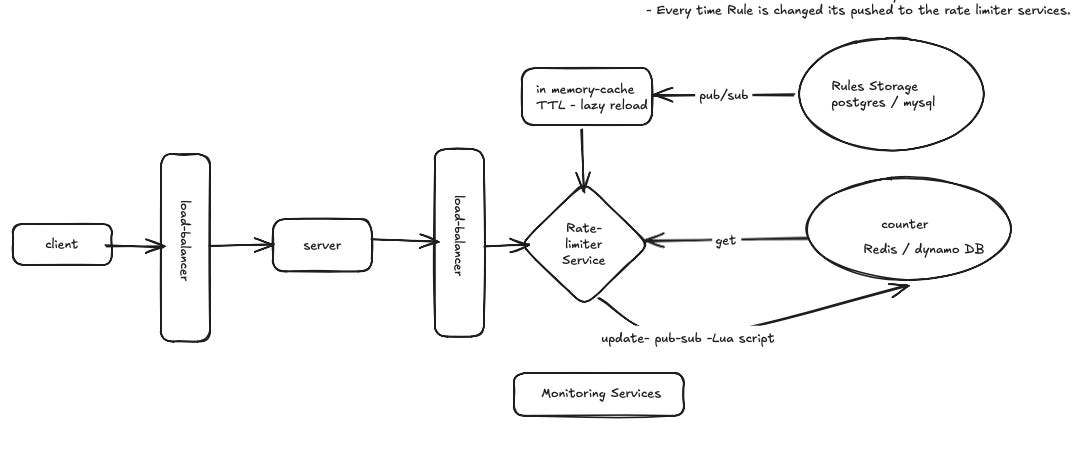
Load Balancer
Routes each client to a consistent limiter node, enabling cache locality.Rate Limiter Nodes
In-memory cache of rate rules, updated via Pub/Sub.
On each request: fetch rule → invoke Redis Lua script → return allow or reject.
Emit metrics (latency, rejects, cache hits).
Redis Cluster
Sharded by key-hash (e.g. 128 shards × 3 replicas).
Stores minimal per-key state (token counts or window counters).
Scripts perform refill, check, and consume in one atomic call.
Pub/Sub Stream
Publishes rule changes (limit, burst size).
Nodes subscribe and refresh cache entries by version or timestamp.
3. Counter Storage & Sharding
Raw footprint:
1 billion keys × 1 KB each = 1 × 10¹² bytes ≈ 1 TBOptimized:
Pack key (8 B) + counter (8 B) → 16 B/entry → ~16 GB rawReplication: 3× → ~48 GB per region
Shard plan:
128 logical shards → ~125 million keys/shard → ~2 GB/shard
Deploy ~4 shards per node → ~32 nodes total
4. Core Algorithms
| Fixed-Window Counter | O(1) per window | No | ±window size error |
| Sliding-Window Log | O(R) timestamps | Yes | Exact |
| Sliding-Window Counter | O(1) | Approximate | Bounded error |
| Token-Bucket | O(1) (2 fields)| Yes (≤ bucket size)| Smooth |
| Leaky-Bucket | Queue length | No (queue delays) | Depends on queue |
Recommended: Token-Bucket or Sliding-Window Counter with a single Redis Lua script for atomic refill, check, and consume.
5. Atomic Request Flow
Lookup rule in local cache.
Redis Lua script:
Refill tokens or rotate counters based on timestamp
Compare against limit
Decrement and return result in one call
Response: HTTP 200 (allow) or 429 (reject) with headers:
X-RateLimit-LimitX-RateLimit-RemainingX-RateLimit-Reset
6. Availability & Scaling
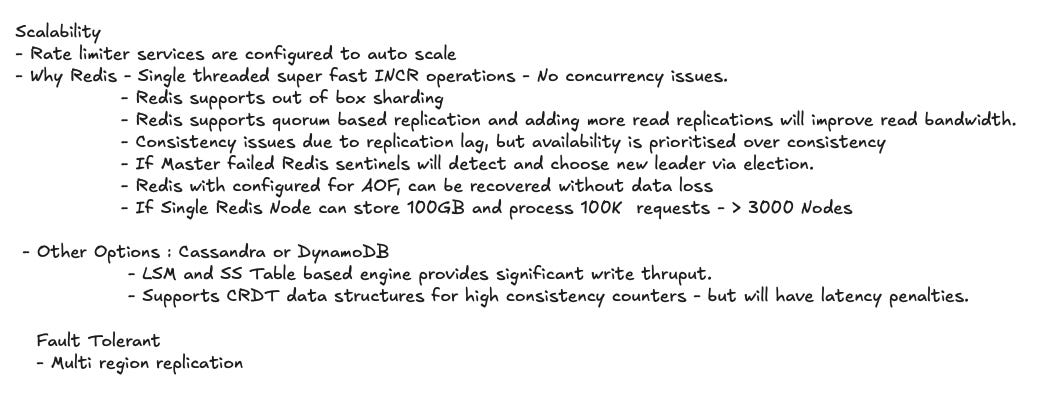
Masterless data store: Redis Cluster or DynamoDB global tables for zero-downtime failover.
Multi-AZ replicas: each shard spans ≥ 3 zones.
Client retries: exponential backoff + configurable “fail-open” for noncritical paths.
Autoscaling: trigger on p99 latency or reject-rate thresholds.
7. Observability & Alerts
Key metrics:
Reject rate (%)
p50/p95/p99 latency
Cache hit ratio
Pub/Sub lag for rule updates
Alerts:
Reject rate > 1% sustained for 5 minutes
p99 latency > 50 ms
Pub/Sub lag > 1 s